
How to Measure Penile Length With a Ruler: The Clinical Method
Introduction: Why Measurement Method Determines Everything
Most men who believe they have a size concern are measuring incorrectly. A 2025 clinical study published in Sexual Medicine found that 72.81% of men overestimated their own erect penile length compared to clinician-measured values, with self-reported figures exceeding actual measurements by an average of 0.92 cm. That gap represents millions of men operating on faulty data, either overconfident or, more often, needlessly anxious.
For any man considering a consultation for penile enhancement, the stakes of accurate measurement are immediate and practical. The number brought to that appointment directly influences treatment planning, filler volume decisions, and procedural safety limits. Bad data produces bad plans.
There is a clinical standard used in every peer-reviewed study and by every urologist, and then is the informal method most men use at home. These two approaches can produce results that differ by 0.5 to well over 1 inch, and that difference separates meaningful data from misleading data.
This is not a casual how-to guide. It is a clinical methodology walkthrough designed to help generate measurements that are medically meaningful and directly comparable to population norms. The following sections cover the two measurement standards (BPEL versus NBPEL), why the suprapubic fat pad changes everything, step-by-step clinical technique, how to interpret results against validated population data, and when accurate measurement becomes the foundation of a productive medical consultation.
The Two Standards: BPEL vs. NBPEL, and Why the Difference Is Not Trivial
Bone-Pressed Erect Length (BPEL) is the clinical gold standard. A rigid ruler is placed along the dorsal (top) surface of a fully erect penis and pressed firmly into the pubic fat pad until it contacts the pubic bone. The measurement is read at the tip of the glans.
Non-Bone-Pressed Erect Length (NBPEL) rests the ruler at the base skin surface without pressing. This measures only visible length and is not comparable to clinical study data.
The distinction is not academic. Every major clinical reference, including the landmark 2015 Veale et al. BJU International systematic review of 15,521 men, used bone-pressed measurements performed by clinicians. Comparing an NBPEL figure to those averages is comparing two different metrics entirely.
The real-world gap is substantial: non-bone-pressed measurements typically run 0.5 to 1 inch shorter than bone-pressed measurements, depending on body fat levels.
NBPEL still has a role. Visible length matters for aesthetics and self-perception, and condom sizing may reference visible length. However, it must be understood as a separate metric. Both measurements carry value; only BPEL is clinically actionable for population comparison and treatment planning.
The Suprapubic Fat Pad: The Variable Most Guides Ignore
The suprapubic fat pad is the layer of adipose tissue that sits above the pubic bone, surrounding the base of the penis. This is precisely the tissue the bone-pressed method compresses to reach the true anatomical base.
The concealment effect is significant. The suprapubic fat pad can hide 1 to 3 cm (roughly 0.5 to over 1 inch) of actual penile length depending on body composition. There is also a direct relationship with body weight: for every 30 to 50 pounds of weight gain, visible (non-bone-pressed) penile length may decrease by approximately 0.5 to 1 inch due to fat pad growth, while actual bone-pressed length remains entirely unchanged.
Consider a man who has gained 40 pounds since his twenties. He may perceive a significant reduction in size that is entirely attributable to fat pad growth, not any anatomical change. The “lost” length is structurally present; it is simply buried.
This is one of the most practically important facts in male anatomy that most men have never encountered, and it is exactly why the bone-pressed method is not optional. It is the only way to measure what is actually there, independent of body composition.
Tools Required Before Starting
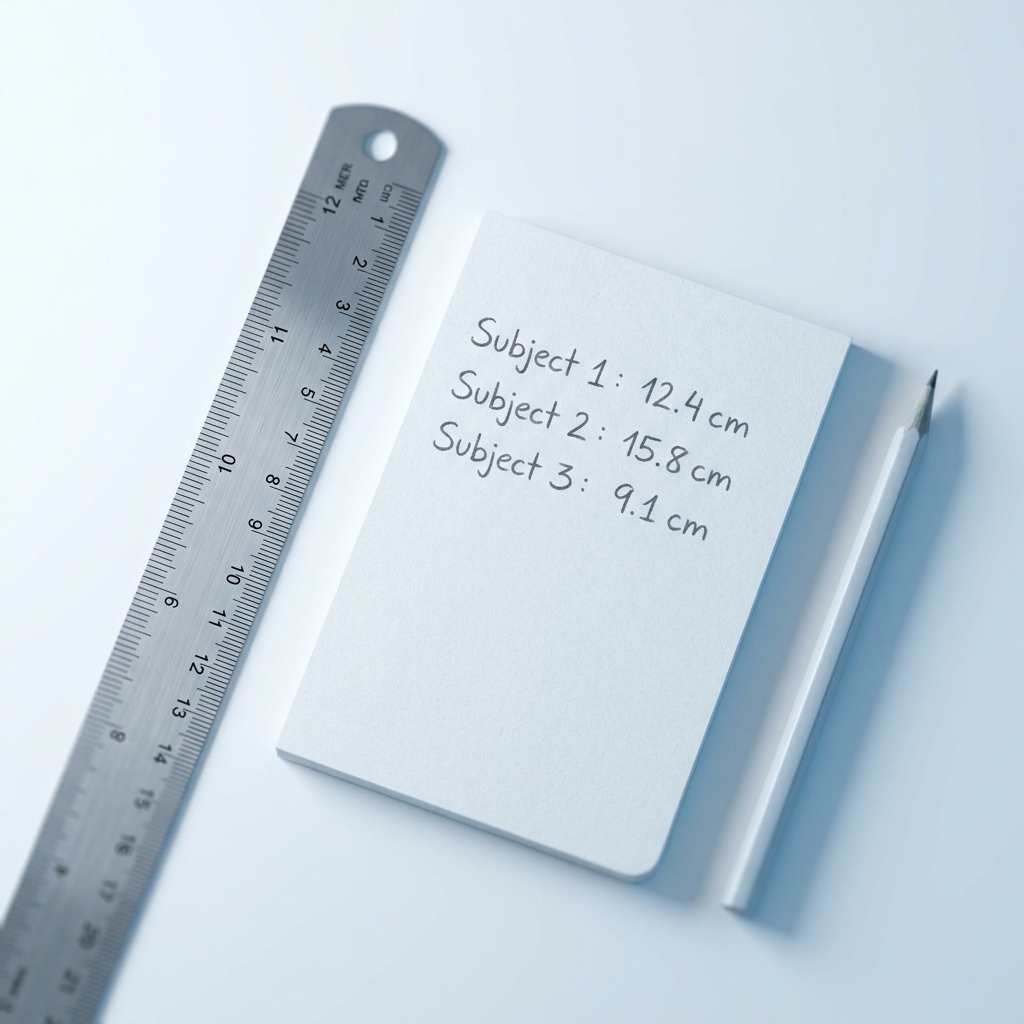
- A rigid ruler, not a flexible tape measure, for length. Flexible tape follows curves and introduces error. A standard 12-inch (30 cm) rigid ruler with clear millimeter markings is ideal. Metal or hard plastic is preferred over wood, which can warp.
- A flexible, non-stretchy measuring tape (a tailor’s tape or similar) for girth. This is the one context where a flexible tape is appropriate.
- A notepad to record multiple measurements, and a phone timer or clock to ensure consistent erection quality across sessions.
What not to use: cloth tape measures that stretch, string-and-ruler methods (which introduce error), and any app or device claiming to measure from a photo.
Environment: measure in a warm room. Cold temperatures cause significant size reduction in both flaccid and erect states. Choose a private setting that allows for full relaxation and consistent arousal.
Step-by-Step: The Clinical Method for Measuring Penile Length
Measurement must be taken at full erection only. Partial erections significantly underestimate true size and produce unreliable data. One position should be chosen, either standing upright or lying flat, and used consistently across all sessions, since position can affect results slightly.
Step 1: Achieve and Confirm Full Erection
A full erection means maximum rigidity, not 80% or 90%. Partial erections are the single most common source of underestimation in self-measurement. Erection quality can be affected by stress, fatigue, alcohol consumption, and time of day, so measuring when rested and relaxed produces the most representative result. If erection quality is inconsistent, measuring across multiple sessions and averaging the results is preferable to relying on a single data point.
Step 2: Position the Ruler on the Dorsal Surface
Place the ruler along the dorsal (top/upper) surface of the penis, the side facing the abdomen when erect. Measuring from the underside (ventral surface) or from the sides introduces anatomical inconsistency and is not comparable to clinical standards. Align the zero end of the ruler at the base of the penis where it meets the pubic area.
Step 3: Press Firmly to the Pubic Bone
This is the defining step of the bone-pressed method. Press the ruler firmly into the suprapubic fat pad until the resistance of the pubic bone is felt beneath. The pressure required will vary based on body composition; men with more suprapubic fat will need to press more firmly to reach the bone. Press firmly and consistently, but not to the point of discomfort. This step is what makes the measurement comparable to the Veale 2015 clinical data and other peer-reviewed population studies.
Step 4: Read the Measurement at the Glans Tip
Read at the very tip of the glans (the head of the penis), not at the corona or any other landmark. Record to the nearest millimeter for precision. If the glans is not perfectly aligned with the ruler due to slight natural curvature, read at the furthest point of the glans tip.
Step 5: Repeat and Average Across Sessions
A single measurement is insufficient. Measuring 2 to 3 times across different sessions (different days, different times) and calculating the average produces a more stable and representative figure, as size fluctuates slightly due to stress, blood flow, sleep quality, and hydration. Each measurement should be recorded with the date and time to track consistency.
Measuring Penile Girth: The Method That Is Often Overlooked
Girth measurement uses a flexible, non-stretchy measuring tape wrapped around the thickest part of the erect shaft, typically at mid-shaft. Wrap the tape snugly but without compression; it should lie flat against the skin without indenting. Record circumference (the full wrap-around measurement), not diameter.
Measure at mid-shaft as the standard location, but note any significant variation along the shaft. Some men carry more girth at the base or near the glans.
Girth matters clinically. Research published in BMC Women’s Health found that women rated girth as more important than length for sexual pleasure. For treatment planning, girth measurements are at least as critical as length. Girth is the primary metric for non-surgical enhancement planning: filler volume calculations, procedural staging, and safety limits for penile girth augmentation all depend on accurate baseline circumference data. As with length, girth should be measured 2 to 3 times across sessions and averaged.
The Stretched Flaccid Length Method: When Consistent Erection Is Difficult to Achieve
Stretched Flaccid Length (SFL) is a clinical proxy. Gently pulling the flaccid penis to maximum extension and measuring bone-pressed correlates more closely with erect length than ordinary flaccid measurement. It still underestimates erect length by roughly 20%, so it is a proxy rather than a substitute, but it is useful when consistent erection quality is difficult to achieve.
Technique: with the penis flaccid, grip the glans and gently stretch to maximum extension without causing discomfort. Place the rigid ruler on the dorsal surface, press to the pubic bone, and read at the glans tip.
Ordinary flaccid length is unreliable. Temperature, stress, physical activity, and time of day all cause significant flaccid fluctuation. The 1996 Wessells et al. Journal of Urology study established that ordinary flaccid length does not reliably predict erect length. This is also the root of the “grower versus shower” phenomenon: some men show minimal flaccid length but significant erection gain, while others show relatively little change. Flaccid appearance is a poor proxy for erect size and should never be used for clinical comparison.
Adapting Technique for Penile Curvature
Men with significant penile curvature, including Peyronie’s disease, cannot achieve accurate length measurement with a rigid ruler pressed against the dorsal surface. For a curved penis, a flexible but non-stretchy measuring tape should be used along the dorsal curve from base to glans tip. This follows the anatomical contour and avoids the compression error a rigid ruler introduces on a curved shaft.
Curvature is itself a clinically relevant finding that should be disclosed during any medical consultation, as it affects both measurement methodology and treatment planning. Mild natural curvature, present in the majority of men, does not significantly affect rigid ruler measurement; this adaptation is primarily relevant for pronounced curvature.
How Measurements Compare to Population Norms
The clinical gold standard remains the 2015 Veale et al. BJU International systematic review of 15,521 clinician-measured men, which found an average penile length of 13.12 cm (5.16 inches) and an average erect circumference of 11.66 cm (4.59 inches). The 2023 World Journal of Men’s Health meta-analysis of 55,761 men found a 24% increase in average erect penile length globally between 1992 and 2021, with a pooled mean of 13.93 cm.
Penile length follows a normal (bell curve) distribution. The difference between the 25th and 75th percentiles is only about 0.88 inches (2.2 cm) in erect length. The range of “normal” is far narrower than most men assume.
A micropenis is clinically defined as an erect or stretched penile length 2.5 standard deviations below the mean, approximately 3 inches (7.6 cm) or less when erect, affecting roughly 0.6% of the male population. This is a medical condition warranting urological evaluation.
There is a therapeutic dimension as well. A 2025 clinical study found that measuring penile dimensions in the erect state significantly reduced anxiety and depression scores in men with small penis anxiety. Accurate measurement is itself a clinical tool. Because self-reported data consistently runs larger than clinician-measured values, the clinical averages used for comparison were themselves measured by professionals using the same bone-pressed standard applied at home.
The Psychological Dimension: What Accurate Measurement Often Reveals
This process carries real emotional weight for men who have carried size concerns for years or decades. The reassuring data is worth noting: 72.81% of men overestimate their own erect penile length compared to clinician-measured values. The most common outcome of accurate self-measurement is discovering that one is closer to average than believed.
Part of the problem is “visual foreshortening.” Looking down at the penis from above creates an illusion that makes it appear shorter than it actually is. This is a documented perceptual bias, not a measurement reality.
The 2023 European Association of Urology (EAU) Guidelines note that men seeking penile augmentation who have normal penile size should be referred for psychological evaluation for potential dysmorphophobic disorders. Accurate measurement is the first clinical step in that diagnostic pathway. A subjective impression of penile size negatively affects sexual function and quality of life in roughly 10% of men, and that impact is real regardless of whether the underlying concern is objectively warranted.
Accurate measurement does not diminish anyone’s experience. It provides real data to work with, either for reassurance or for an informed conversation with a medical provider. The psychological benefits of penile enhancement are well-documented for men who proceed with treatment after accurate measurement confirms a genuine concern.
From Home Measurement to Medical Consultation: Why the Data Matters
Arriving at a consultation with accurate BPEL and girth measurements has direct clinical utility. Providers use these numbers to determine candidacy for enhancement, appropriate filler volume, and realistic outcomes. Filler volume, procedural staging, and safety limits for penile girth augmentation all depend on precise baseline data, and inaccurate figures lead to suboptimal planning.
The EAU 2023 Guidelines state plainly that “a detailed medical and psychosexual history and precise measurements of penile size are essential in the diagnostic pathway.” Home measurements, done correctly, are the starting point of that pathway.
With accurate data, a provider can compare BPEL to population nomograms, assess the gap between bone-pressed and non-bone-pressed length (which indicates fat pad contribution), and tailor a customized treatment plan to the individual’s anatomy. For men who have completed accurate measurement and are considering non-surgical girth enhancement, the logical next step is a consultation with a qualified provider who can translate that data into a personalized treatment plan.
Non-Surgical Penile Girth Enhancement: What Accurate Measurement Makes Possible
For men who have measured accurately and are weighing their options, non-surgical penile girth augmentation using collagen-stimulating dermal fillers (sometimes called filler phalloplasty) is an outpatient procedure completed in under one hour, with no cutting and no general anesthesia.
Baseline measurements directly inform the procedure. Girth measurements establish the starting point, filler volume requirements, and the staged treatment approach used to achieve proportional, natural-looking results. Realistic outcomes include an increase of up to 1 to 1.5 inches in girth, with 80 to 90% permanent improvement, immediate visible enhancement, and results that look and feel natural in both flaccid and erect states.
The procedure starts at $7,500 and increases depending on desired results, priced per syringe. Most men begin with a minimum of 10 syringes, and the average first procedure involves approximately 15 syringes. Recovery is fast: normal activity resumes in about 10 days, with sexual activity resumable within 7 to 10 days, significantly quicker than surgical alternatives.
Accurate measurement is the prerequisite. Men who arrive with verified BPEL and girth data enable their provider to create a more precise, safer, and more effective treatment plan from the first appointment.
Common Measurement Mistakes and How to Avoid Them
- Measuring at partial erection. The single most common error. Always confirm full rigidity first.
- Using a flexible tape for length. It follows curves and body contours, producing inflated or inconsistent readings.
- Measuring from the ventral (underside) surface. This is not the clinical standard and is not comparable to published data.
- Failing to press to the bone. The most consequential error for men with any suprapubic fat; skipping the bone-press can understate true length by 1 to 3 cm.
- Measuring only once. Stress, blood flow, and sleep quality cause fluctuation. Always average across 2 to 3 sessions.
- Measuring in cold conditions. Cold causes significant size reduction in both flaccid and erect states. Always measure in a warm environment.
- Comparing NBPEL to clinical study averages. The Veale 2015 and other peer-reviewed averages are BPEL measurements. Comparing an NBPEL figure to those numbers will make anyone appear smaller than they actually are relative to the population.
Conclusion: Measurement Is the Foundation of Informed Action
The difference between an accurate measurement and an inaccurate one is not just a number. It is the difference between data that can guide a medical consultation and data that cannot.
The key clinical facts bear repeating: BPEL is the only measurement comparable to population norms; the suprapubic fat pad can conceal 1 to 3 cm of actual length; 72.81% of men overestimate their size; and accurate measurement is the first step in any clinical diagnostic pathway.
For many men, completing this process accurately for the first time produces reassurance rather than alarm. For others, it provides the concrete data needed for a productive, informed conversation with a provider. Whether the measurement reveals a figure within the normal range or confirms a long-held concern, the result is a clinical foundation for action.
Accurate self-measurement, performed with the bone-pressed clinical method, is not vanity. It is the responsible starting point for any man who takes his health, confidence, and sexual wellness seriously.
Ready to Turn Your Measurements Into a Treatment Plan? Schedule a Free Consultation
For men who have completed accurate BPEL and girth measurements and are considering non-surgical penile girth enhancement, the next step is a free consultation with Stoller Medical Group / Penis Enlargement New York City.
Bringing those measurements to the appointment allows providers to assess candidacy, discuss realistic outcomes, and design a staged treatment plan tailored to individual anatomy and goals. The practice has performed over 15,000 enlargement procedures and maintains a medical-first approach centered on safety, natural results, and discretion.
Treatment starts at $7,500, priced by syringe, with most men beginning with a minimum of 10 syringes and an average first procedure involving approximately 15 syringes. The consultation is the appropriate place to discuss volume, staging, and cost based on specific measurements and goals.
Free, confidential consultations are available at five locations:
- Manhattan, NY: 515 Madison Avenue, Suite 1205
- Long Island, NY: 366 N Broadway, Suite LE2, Jericho
- Albany, NY: 1202 Troy Schenectady Road, Building No. 2, Latham
- Pennsylvania: 1212 Baltimore Pike, Chadds Ford
- Minnesota: 2121 Cliff Drive, Suite 210, Eagan
Book a free consultation and turn accurate measurement into an informed, personalized plan.