
Foods to Help ED in 2026: The Dose-Reality Evidence Review
Introduction: Why Every ‘Foods for ED’ List Reads the Same (And Why That’s a Problem)
A large share of men searching for “foods to help ED” fit a recognizable profile: between 25 and 54, often successful professionals, and quietly researching nutrition before deciding whether a doctor’s visit is necessary. It is a reasonable first step. Diet is private, controllable, and free of the awkwardness of a clinical conversation.
The problem is what these men find. Nearly every ranking article recycles the same 2016 Harvard and University of East Anglia flavonoid study, followed by a near-identical list of berries, pistachios, and watermelon. Few explain how much of any food would actually be required, and fewer still mention what professional medical bodies say about diet and erectile function.
This review takes a different approach. It runs the math on serving sizes, highlights the 2026 Mediterranean diet network meta-analysis (which found a +2.94 point improvement on the IIEF-5 erectile function scale), and summarizes guideline language from the American Urological Association (AUA) and European Association of Urology (EAU).
The honest framing is this: diet is a legitimate, evidence-backed lever. Professional bodies, however, classify it as Grade C adjunct support, not a replacement for clinical evaluation. That distinction matters because ED affects roughly 1 in 4 American men on standardized questionnaires, yet only 7.7% of men with symptoms are ever formally diagnosed.
The Problem With Most ‘Foods to Help ED’ Content
The 2016 analysis of the Health Professionals Follow-Up Study, which tracked more than 25,000 men, is real and valuable research. The issue is that most health publishers now treat it as the only evidence.
Its actual findings:
- Men consuming 3 to 4 weekly servings of flavonoid-rich foods (berries, citrus, red wine) had roughly a 10% lower risk of ED.
- Higher total fruit intake alone was linked to a 14% reduction in risk.
- Flavonoids combined with regular exercise cut risk by 21%, the largest effect observed.
One caveat that most articles omit: the benefit was significant primarily in men under 70. That matters for interpreting who is most likely to benefit.
A second shortcoming is the absence of dosage context. Food lists are presented as though eating a given item is inherently therapeutic, without telling readers whether a “serving” is realistic or clinically meaningless. The remainder of this article serves as a corrective: dose-reality math, newer research, and guideline-based honesty.
The Science That Actually Matters in 2026
Not all evidence carries equal weight. Pattern-level randomized trials outrank single-food observational associations, and both outrank anecdote. The following sections outline that evidence hierarchy, the kind rarely presented in typical wellness content.
The 2026 Mediterranean Diet Network Meta-Analysis
A 2026 network meta-analysis pooled 11 randomized controlled trials comparing dietary interventions in adult men with ED. Its key findings:
- The Mediterranean diet produced a mean IIEF-5 improvement of 2.94 points versus a standard diet (95% CI 1.40 to 4.49).
- Its SUCRA ranking score showed a 97.6% probability that the Mediterranean diet is the optimal regimen among those tested, outperforming other dietary patterns.
This aligns with a systematic review in the Asian Journal of Andrology, which concluded that men with ED should adopt a low-fat or Mediterranean-style diet with more fruits, vegetables, and nuts.
Why this matters: this is pattern-level evidence, meaning an entire way of eating was tested, not a single “superfood.” That represents a meaningfully stronger evidence class than the isolated food claims dominating most articles.
The Mechanism: Nitric Oxide, Flavonoids, and Arterial Flexibility
An erection is fundamentally a vascular event. Flavonoids and polyphenols are believed to improve endothelial function, the health of the inner lining of blood vessels, making arteries more flexible and responsive.
The central molecule is nitric oxide, which signals blood vessels to relax and widen. Plant-based, polyphenol-rich diets appear to increase nitric oxide bioavailability. This is the same pathway targeted by PDE5 inhibitor medications such as sildenafil and tadalafil.
In other words, diet and prescription ED treatment are not separate systems. They act on a shared biological target, which explains both why diet can help and why it typically produces more modest effects than medication.
Food-by-Food Dose Reality Check: What It Would Actually Take
| Food | Active Compound | Trial Dose | Real-Food Equivalent | Verdict |
|---|---|---|---|---|
| Watermelon | L-citrulline | 1.5 g/day (supplement trials) | ~900 g (about 2 lbs) daily | Healthy food, not a dosed intervention |
| Pistachios | Arginine, polyphenols, healthy fats | 100 g/day for 3 weeks | ~3/4 cup daily | Realistic dose; small positive trial |
| Pomegranate juice | Polyphenols/antioxidants | Daily juice (RCT) | 1 glass daily | Trend only; not statistically significant |
| Dark chocolate/cocoa | Cocoa flavanols | 200 mg/day (EFSA vascular claim) | Highly variable by product | Vascular support; no direct ED trial |
| Berries, citrus, greens, fish | Flavonoids, nitrates, omega-3s | 3 to 4 servings/week | Easily achievable | Best as part of a dietary pattern |
Watermelon and Citrulline: The 900-Gram Problem
Watermelon’s reputation as “natural Viagra” rests on its L-citrulline content. The body converts citrulline into arginine, a precursor to nitric oxide.
The math, however, does not hold up. Matching the 1.5 g of L-citrulline used in supplement trials would require roughly 900 g of watermelon daily, about two pounds. That is not a realistic daily habit, and any clinically meaningful effect seen in supplement studies is unlikely to transfer to normal fruit-level intake.
Verdict: Watermelon is a healthy, hydrating food. It is not a dosed intervention.
Pistachios: The Food With an Actual Positive Trial
Pistachios are one of the few foods with direct ED trial data. In a pilot study, 17 men with ED ate 100 g of pistachios daily for three weeks. Their IIEF scores increased by 151%, alongside improved cholesterol markers.
Honest caveats apply: the sample was small (n=17), the duration short, and there was no placebo arm. The result is promising but preliminary.
What makes pistachios notable is that the dose is achievable. At roughly three-quarters of a cup per day, this is one of the rare cases where the dose math checks out, though calorie load is worth considering.
Pomegranate Juice: Promising Headlines, Non-Significant Data
Pomegranate juice is frequently cited as “proven.” The primary randomized, placebo-controlled trial tells a more nuanced story: 47% of men reported improvement on pomegranate juice versus 32% on placebo.
That difference did not reach statistical significance. The statistically honest conclusion is that a trend was observed, but the study could not confirm a real effect. Citing it as proof misrepresents the primary source.
Dark Chocolate and Cocoa Flavanols: Real Vascular Backing, Not ED-Specific Proof
The European Food Safety Authority (EFSA) recognizes that 200 mg of cocoa flavanols daily helps maintain normal blood vessel function. That is meaningful regulatory backing for vascular health.
It is not, however, ED-specific evidence. No large randomized trials have directly tested dark chocolate as an ED treatment.
Practically, flavanol content varies dramatically by product. Cocoa percentage alone is an unreliable guide, because processing methods such as alkalization (“Dutch processing”) can destroy a large share of flavanols. Some high-cocoa bars may approach 200 mg in a modest portion while others deliver a fraction of that. Men pursuing this route should favor minimally processed, high-cocoa products and keep sugar and calorie intake in mind.
Berries, Citrus, Leafy Greens, and Fatty Fish: The Supporting Cast
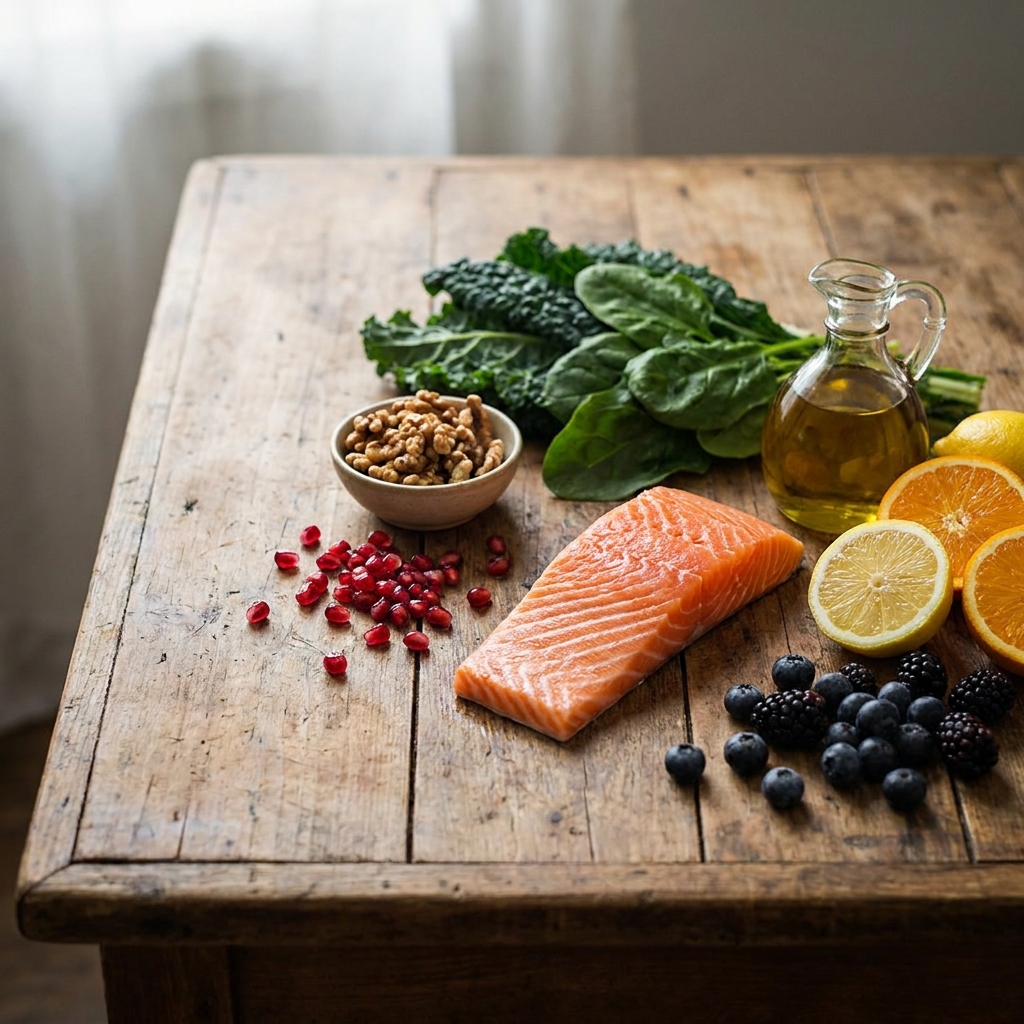
Berries and citrus are the foods underlying the original flavonoid study. Leafy greens supply dietary nitrates, and fatty fish provides omega-3 fatty acids; both are core components of the Mediterranean pattern that produced the +2.94 IIEF-5 result.
Their value lies in regular consumption as part of a dietary pattern (at least 3 to 4 times weekly), not as isolated superfoods eaten occasionally.
Foods and Habits That Work Against Erectile Health
The National Institute of Diabetes and Digestive and Kidney Diseases (NIDDK) advises limiting:
- Foods high in saturated fat, such as red meat and fried foods
- Full-fat dairy
- Refined carbohydrates
- Foods and drinks high in sodium and added sugars
- Packaged and processed foods
- Alcohol
Why These Foods Matter: The Comorbidity Connection
Generic “avoid processed food” advice misses the real point. These foods matter because they drive the diseases that cause ED.
- Roughly 66% of men with diabetes worldwide experience ED.
- ED prevalence among men with hypertension is approximately 60%.
Foods that worsen glycemic control, raise blood pressure, and promote arterial plaque damage the same endothelial and nitric oxide pathways that erections depend on. The “avoid” list is better understood as cardiovascular and metabolic risk management, not a weight or appearance concern.
What the Clinical Guidelines Actually Say About Diet and ED
The AUA’s Grade C, Moderate Recommendation
The American Urological Association guideline states that clinicians should counsel ED patients with comorbidities that lifestyle modifications, including changes in diet and increased physical activity, improve overall health and may improve erectile function.
This is classified as a Moderate Recommendation, Grade C evidence. In plain terms, Grade C means the supporting evidence is credible and directionally positive but carries lower certainty, often drawn from observational studies or trials with limitations. It is not a “first-line cure” classification.
The EAU’s Parallel-Initiation Approach
The European Association of Urology states that lifestyle changes and risk factor modification should be initiated prior to, or at the same time as, other ED treatments.
The practical implication is significant: diet and medical evaluation are designed to run in parallel, not sequentially. A long wait-and-see period with diet alone is not what the guidelines describe.
What ‘Adjunct’ Really Means in Practice
Translated into practical terms, diet can meaningfully help, particularly for men with mild-to-moderate, vascular-linked ED. But no major guideline body positions it as a substitute for diagnosis. That honest framing stands in contrast to wellness-blog language implying that food alone can “cure” ED.
When Diet Isn’t Enough: Reading the Warning Signs
Harvard researchers have described ED as a vascular “canary in the coal mine.” It often precedes a cardiovascular disease diagnosis and offers a critical window to intervene before heart attack or stroke.
The condition is common, not shameful. Global prevalence was projected to reach approximately 322 million men by 2025, yet only 7.7% of men with symptoms have been formally diagnosed.
Signals that warrant professional evaluation include:
- ED persisting despite 8 to 12 weeks of consistent dietary and lifestyle change
- ED accompanied by fatigue or low libido, which may indicate a testosterone factor
- ED alongside known risk factors such as diabetes, hypertension, or high cholesterol
ED can also stem from psychological, hormonal, neurological, or medication-related causes that nutrition cannot address. Diet is one pillar, not the whole picture.
A Realistic 2026 Action Plan for Dietary Change
Building a Mediterranean-Style Plate
A practical daily structure based on the research:
- Vegetables and fruit at most meals, including berries, citrus, and leafy greens
- Nuts as a daily snack, with a realistic pistachio portion
- Fatty fish (salmon, sardines, mackerel) several times weekly
- Olive oil as the primary fat
- Limited red meat and refined carbohydrates
This pattern, not any single superfood, produced the +2.94 IIEF-5 result.
Pairing Diet With Activity
The original flavonoid study found that diet plus exercise produced the largest risk reduction (21%), greater than either alone. Dietary change is best treated as one half of a two-part lifestyle intervention.
Knowing the Right Time to Get Evaluated
Men making changes should track symptom response over a defined window of roughly two to three months rather than waiting indefinitely. Vascular and testosterone screening can identify underlying causes diet cannot resolve. Seeking evaluation early aligns with the EAU’s parallel-initiation guidance; it is not a last resort.
Beyond the Plate: Confidence, Evaluation, and Treatment Options
Many men researching this topic are motivated by confidence and satisfaction concerns as much as clinical symptoms. High-performing professionals, in particular, often delay addressing either concern out of discretion or uncertainty about where to start.
It helps to separate two conversations. ED is a functional, often vascular issue best addressed through medical evaluation and supported by diet. Confidence and satisfaction concerns related to size or self-perception are a separate, though related, conversation.
Stoller Medical Group addresses the latter. For men who have done the work on health and lifestyle but still want to address confidence, the practice offers a discreet, medically supervised option: non-surgical girth enhancement using Belefil®, a hyaluronic acid-based dermal filler. Procedures are performed by Dr. Roy B. Stoller’s team, which has completed over 15,000 enlargement procedures. Treatment is outpatient, takes under an hour, and requires no cutting or general anesthesia.
On investment: cost starts at $7,500 and increases depending on desired results. Pricing is calculated per syringe; most men start with a minimum of 10 syringes, and the average first procedure uses 15 syringes.
Free consultations are available at five locations: Manhattan, Long Island, Albany, Chadds Ford (PA), and Eagan (MN). Importantly, any underlying vascular, hormonal, or psychological cause of ED should be addressed by a qualified physician first. Enhancement addresses confidence; it does not treat erectile dysfunction.
Conclusion
The honest verdict on foods to help ED in 2026:
- Mediterranean-pattern eating has the strongest evidence, with a +2.94 IIEF-5 improvement across 11 RCTs.
- Pistachios have a real, if small, positive trial at a realistic dose.
- Watermelon and pomegranate claims do not survive dose or statistical scrutiny.
Diet is a legitimate, physician-endorsed adjunct (AUA Grade C, EAU parallel initiation), not a substitute for diagnosis. Men who have made genuine dietary and lifestyle changes without improvement should treat that as a signal to get evaluated, not a reason to keep guessing. Researching the topic seriously, rather than accepting the first wellness-blog list, is already a meaningful step.
Next Steps: Get a Clear Picture of Your Health
Stoller Medical Group offers free, discreet consultations for men who want to discuss their symptoms, lifestyle efforts, and whether further evaluation (vascular, testosterone, or confidence-related options) makes sense.
With offices in Manhattan, Long Island, Albany, Chadds Ford, and Eagan, men can discuss both medical concerns and non-surgical enhancement in a single confidential visit. There is no obligation, only a clearer picture of where things stand and which path, if any, fits individual goals.