
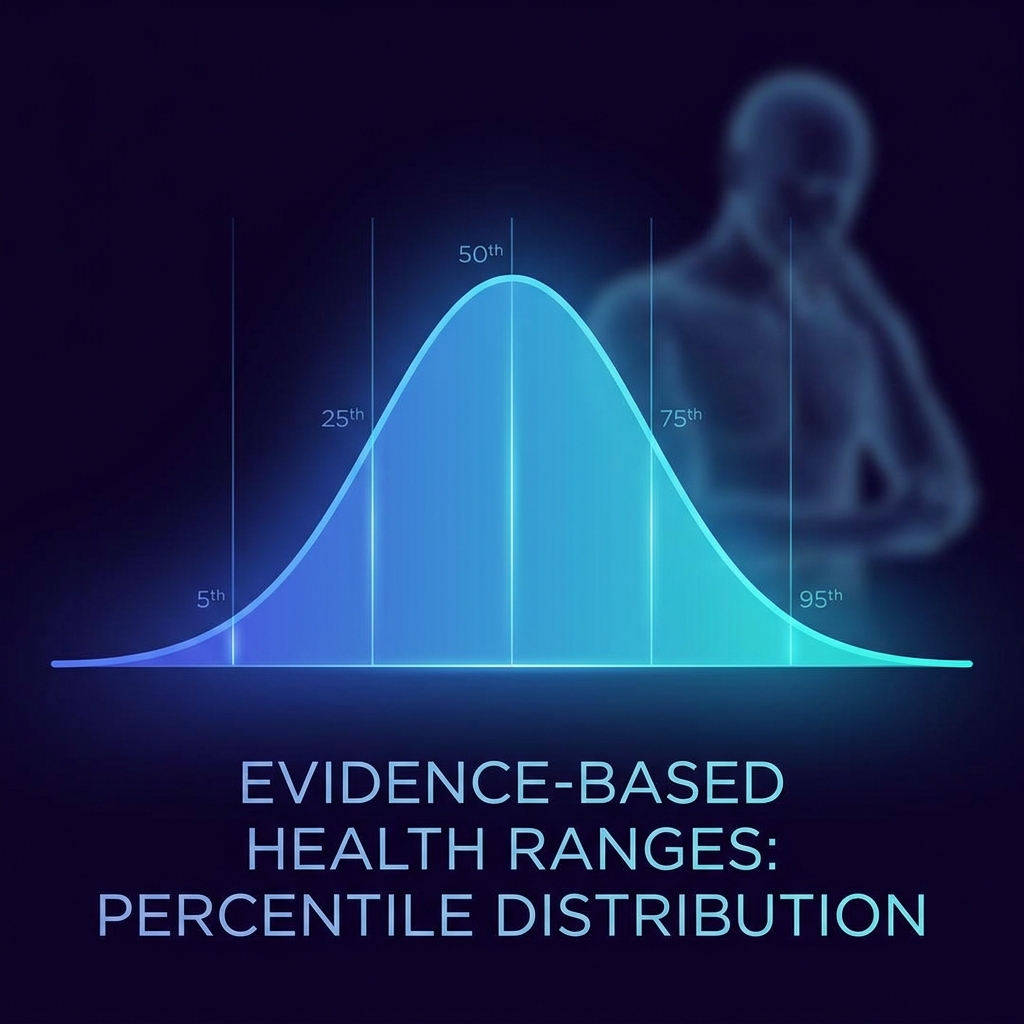
Penile Size Chart: The Girth Percentile Data Most Men Never See
Introduction: The Girth Data Most Men Never Actually See
Men search for penile size charts constantly, yet the single most clinically relevant dimension, girth, is consistently underrepresented. It gets buried beneath length data, folded into the same table, or drawn from unreliable self-reported surveys that inflate every number they touch.
This article corrects that. Two sources anchor everything that follows: Veale et al. (2015, BJU International), the gold-standard systematic review of 15,521 clinician-measured men, and Mostafaei et al. (2025, Urology Research and Practice), the most recent large-scale meta-analysis pooling 36,883 men. These are clinician-measured datasets, not self-reports, and that distinction matters more than most men realize.
Here is why: a 2025 study in Sexual Medicine (Oxford Academic) found that 72.81% of men overestimate their erect size. In other words, most men are benchmarking themselves against a number that is already inflated before they ever open a chart. The anxiety driving the search is often built on a measurement error.
By the end of this piece, the reader will have a clinically accurate girth percentile chart, a clear understanding of what the bell-curve distribution actually means on a personal level, and an honest look at what options exist for men who want to explore change. This is data-driven self-knowledge, approached the same way any professional would treat a health metric: calmly, factually, and without drama.
Why Girth, Not Length, Is the Clinically Relevant Dimension
The anatomical case for girth is straightforward. The nerve endings responsible for sensation are concentrated in the first three to four inches of the vaginal canal. Circumference creates more consistent stimulation across that zone than additional length does for most partners.
The research supports this. Prause et al. (2015, PLOS ONE) used 33 3D-printed penis models and found that women selected a long-term partner with roughly 4.8 inches of girth, only modestly above the clinical average. Notably, women recalled circumference more accurately than length, suggesting girth is the more perceptually salient dimension. A separate BMC Women’s Health analysis found that women who expressed a size preference were more likely to cite girth over length.
There is also a notable satisfaction gap. In a large survey, 84 to 85% of women reported satisfaction with their partner’s size, while only 55% of men reported satisfaction with their own. That 30-point gap is not driven by anatomy; it is driven by perception.
Length charts are widely available. Girth charts are not. That information vacuum is precisely what this article fills, focusing exclusively on circumference rather than diluting the signal across two dimensions.
The Measurement Problem: Why 72.81% of Men Are Working From the Wrong Number
The 2025 Oxford Academic study measured 342 men and found that 72.81% overestimated their erect length, with self-reports exceeding clinician-measured values by an average of 0.92 cm (about 0.36 inches). Self-reported girth carries similar, and potentially larger, bias. Circumference requires a flexible tape measure and a consistent measurement point, both of which are easy to get wrong.
Across the literature, self-reported data overestimates by roughly 0.5 to 0.7 inches compared to clinician measurements. This is exactly why the Veale nomograms, built entirely from health-professional measurements, are the preferred clinical benchmark.
The practical implication is significant. A man who believes he measures 4.2 inches based on his own tape may actually sit closer to 3.8 to 4.0 inches under clinical measurement, which shifts his percentile position meaningfully. Before consulting any chart, a reader needs to know whether his number is reliable. That is why the measurement protocol comes first.
How to Measure Penile Girth Accurately (Clinical Protocol)
The clinical standard is precise: girth is measured at the midpoint of the fully erect penis using a flexible, non-stretchable tape measure. Not a ruler. Not a string. Not a cloth tape that stretches under tension.
The erect-state requirement is non-negotiable. Flaccid girth is a weak predictor of erect girth because of the well-documented “grower versus shower” phenomenon. Flaccid measurements are not a valid substitute when comparing against the Veale or Mostafaei normative data.
The protocol:
- Achieve a full erection.
- Locate the midpoint of the shaft.
- Wrap the tape snugly but not compressively around the circumference.
- Record in inches to one decimal place.
Common errors that inflate results: measuring at the widest point instead of mid-shaft, using a stretchy tape, pressing the tape into soft tissue, or measuring at less than full erection.
Note that girth measurement is distinct from length measurement, which is taken bone-pressed along the dorsal side. These are separate protocols, and the two numbers should never be confused when reading a chart. This method is the same one used in the Veale and Mostafaei studies, which is what makes it the only valid basis for comparison. For a more detailed walkthrough of the full measurement process, see this guide on how to measure your penis accurately.
The Erect Girth Percentile Chart: What the Clinical Data Actually Shows
Below are erect girth percentiles derived from Veale et al. (2015) and cross-referenced with Mostafaei et al. (2025):
| Percentile | Erect Girth (inches) | Erect Girth (cm) |
|---|---|---|
| 5th | ~3.5 in | 8.9 cm |
| 10th | ~3.7 in | 9.4 cm |
| 25th | ~4.2 in | 10.7 cm |
| 50th (median) | ~4.6 in | 11.7 cm |
| 75th | ~5.0 in | 12.7 cm |
| 90th | ~5.2 in | 13.2 cm |
| 95th | ~5.3 in | 13.5 cm |
The average anchors the chart. Veale et al. (2015) reports a mean erect girth of 11.66 cm (4.59 inches). Mostafaei et al. (2025) reports a pooled mean of 11.91 cm (4.69 inches). Both are consistent, and the slight difference reflects different study pools and regional compositions. The Sexual Medicine Society of North America (SMSNA) independently confirms an average erect circumference of about 4.5 inches, providing authoritative third-party validation.
An honest caveat: the Veale erect circumference nomogram is based on a sub-sample of 381 men across two studies, compared to 15,521 for the length nomogram. This makes girth data slightly less statistically robust than length data. Transparency here matters more than the appearance of certainty.
Regional variation exists but is modest. Mostafaei et al. (2025) found the Americas region showing the largest mean flaccid circumference at 10.00 cm (3.94 in). Within-region variation dwarfs between-region variation, so the overall distribution is far more useful for individual benchmarking than any regional average. For reference, Veale reports a mean flaccid girth of 9.31 cm (3.66 inches), though flaccid state remains a poor predictor of erect state. A broader look at penis size data across populations reinforces how tightly clustered most measurements actually are.
Understanding the Bell Curve: What a Percentile Actually Means
Erect girth follows a normal distribution, a bell curve. Most men cluster near the center, and measurements at the extremes are genuinely rare, not just statistically uncommon but clinically unusual.
The most important reframe is this: approximately 68% of men fall within one standard deviation of the mean, roughly 4.1 to 5.1 inches of erect girth. That is a band less than one inch wide. Two out of three men are within a fraction of an inch of one another.
Extending to two standard deviations, roughly 95% of men fall between about 3.6 and 5.6 inches. A man at 3.7 inches and a man at 5.5 inches are both firmly inside the normal clinical range. Only 5% of men exceed roughly 5.3 inches, which is a useful reality check for anyone whose expectations have been shaped by media or pornography that presents outliers as typical.
The bell-curve framing is more psychologically useful than a raw percentile table. Learning that one sits at the 35th percentile feels worse than learning one is inside the same one-inch band as 68% of all men. Same data; more accurate frame. Because flaccid girth poorly predicts erect girth, men who appear smaller when flaccid are not reliably smaller when erect. The bell curve applies to erect measurements only.
The Psychology Behind Size Concern: Normal Anxiety vs. Clinical Distress
Size concern is common, not fringe. A 2026 review in Sexual Medicine Reviews (Oxford Academic) noted that 42 to 55% of men in community samples express some concern about penile adequacy, making it one of the most prevalent male body-image concerns.
Three clinical categories are worth distinguishing:
- Normal concern: curiosity or mild self-consciousness that does not impair functioning.
- Small penis anxiety (SPA): persistent worry despite normal measurements.
- Penile dysmorphic disorder (PDD): a clinically significant variant of body dysmorphic disorder under DSM-5-TR, marked by obsessive preoccupation and functional impairment.
The COPS-P screening tool (Veale et al., 2015), a validated 9-item scale, distinguishes PDD from SPA and normal concern. Most men searching for a size chart fall into the first two categories, not the third.
The satisfaction gap tells the story clearly. With 84 to 85% of women satisfied with their partner’s size but only 55% of men satisfied with their own, the evidence points squarely at perception rather than anatomy. Lower male genital self-image is also associated with higher depression and anxiety scores, which is why accurate size information is a legitimate mental-health resource, not merely a curiosity.
For men whose concern feels obsessive, disrupts daily functioning, or persists despite accurate data, speaking with a mental health professional familiar with body dysmorphic disorder is a reasonable step. That is a supportive signpost, not a diagnosis. For the majority in the normal-to-SPA range, accurate data is the most effective intervention. For those who still want to explore what can realistically change, evidence-based options exist.
What Can Realistically Change: The Evidence on Girth Enhancement
Most men who seek girth enhancement fall within the normal range. The decision to pursue it is a personal preference, not a medical necessity, and it should be approached with accurate expectations.
Hyaluronic acid (HA) dermal filler is the leading evidence-based non-surgical option for girth augmentation. It targets circumference exclusively, which aligns directly with the focus of this article.
The clinical data is encouraging. Carey et al. (2024, Journal of Sexual Medicine) treated 155 men and found an average girth increase of 0.633 cm per treatment and 1.8 cm across multiple treatments. Raheem et al. (2025, Journal of Sexual Medicine) followed 324 patients for a mean of nine months, reporting a mean flaccid girth increase of 2.5 cm, 89% patient satisfaction, and no serious adverse events. An AUA News clinical overview (2024) reviewed retrospective safety data on nearly 500 men and found all complications minor and manageable: asymmetry around 6%, filler migration around 7.7%, lumps around 4.6%, and infection around 1.5%.
On longevity, HA filler averages about 12 months (range 9 to 24 months) before reinjection is needed. It enhances girth and volume, not length, which is an honest and important boundary to set. Surgical penile lengthening, by contrast, carries a notably higher risk profile, and some providers deliberately choose not to offer it for that reason. Men weighing their options may also find it useful to compare filler phalloplasty versus surgical phalloplasty side by side before making any decisions.
What to Look for in a Girth Enhancement Provider
Provider selection is the single most important variable in both safety and outcome quality for HA filler procedures.
Key criteria include a board-certified physician with documented experience in penile filler placement specifically (not general aesthetic filler work), advanced training in male pelvic and penile vascular anatomy, hospital-grade sterility protocols, and medical-grade biocompatible filler materials.
A staged treatment approach, where the provider recommends incremental sessions rather than a single dramatic change, signals a conservative, safety-first philosophy. Transparency is equally important: reputable providers offer comprehensive consultations, realistic goal-setting, detailed informed consent, and clear aftercare guidance before any procedure is discussed.
Volume matters. A provider who has performed thousands of procedures has managed the full range of anatomical variations and minor complications, a depth of experience impossible to replicate in a low-volume setting.
Red flags: promises of dramatic single-session results, no discussion of complications, unverified filler materials, or no formal consultation process. Men in the Northeast and Mid-Atlantic should also know that multi-location practices with dedicated male enhancement specialization exist, reducing the need to travel to a single flagship site.
Penile Girth Enhancement at Stoller Medical Group: Clinical Approach and What to Expect
Stoller Medical Group, operating as Penis Enlargement New York City, has performed over 15,000 procedures, making it one of the highest-volume non-surgical male enhancement practices in the United States.
The procedure is non-surgical filler phalloplasty using Belefil®, a hyaluronic acid-based, medical-grade, biocompatible dermal filler placed beneath the penile skin to enhance girth and volume. It is an outpatient treatment completed in under one hour with no general anesthesia.
Results profile: up to 1 to 1.5 inches increase in girth, 80 to 90% permanent improvement in girth and volume, and results that look and feel natural in both flaccid and erect states while maintaining normal sensation and function.
Recovery: patients are back on their feet in 10 days, compared to 40-plus days with other permanent filler options, and sexual activity can typically resume within 7 to 10 days.
The practice uses a staged approach, favoring multiple sessions over a single dramatic procedure. This aligns with the clinical evidence for improved symmetry, reduced risk, and smoother outcomes.
On pricing: the procedure starts at $7,500 and scales with desired results. Pricing is by syringe, with most men starting at a minimum of 10 syringes and averaging around 15 syringes during their first procedure. Total investment scales based on goals and individual anatomy.
Glans and scrotal enhancement can be performed simultaneously with shaft treatment for men seeking comprehensive results. Five locations serve patients across New York (Manhattan at 515 Madison Avenue, Long Island in Jericho, and Albany in Latham), Pennsylvania (Chadds Ford), and Minnesota (Eagan), with free consultations available at each. Notably, the practice does not offer surgical penile lengthening, a deliberate, safety-first decision that reflects its medical philosophy.
Frequently Asked Questions About Penile Girth and the Size Chart
Is 4.5 inches girth normal?
Yes. The clinician-measured mean is 4.59 inches (11.66 cm) from the largest systematic review available (Veale et al., 2015, 15,521 men). A man at 4.5 inches sits at roughly the 50th percentile.
What is considered large girth?
The 90th percentile sits at approximately 5.2 inches and the 95th at approximately 5.3 inches. Fewer than 1 in 10 men exceed 5.2 inches erect.
Why does a self-measured girth differ from the chart?
Because 72.81% of men overestimate their size (2025 Oxford Academic study). The wrong measurement point, a stretchy tape, or less than full erection will systematically inflate results. Clinician-measured data is the only valid benchmark.
Does flaccid girth predict erect girth?
No. The “grower versus shower” phenomenon means flaccid state is a weak predictor. The chart applies to erect measurements only.
Does regional or ethnic background affect girth?
Modest regional variation exists (Mostafaei et al., 2025), but within-group variation is far larger than between-group variation. The overall bell curve is the more useful reference for any individual.
Can girth be increased non-surgically?
Yes. HA filler is the leading evidence-based option, with mean increases of 1.8 cm across multiple treatments (Carey et al., 2024) and a 2.5 cm flaccid girth increase at 89% satisfaction (Raheem et al., 2025). Men curious about what the penis girth enhancement procedure steps involve can review the full clinical process before committing to a consultation.
How long do HA filler results last?
Results typically last 18 to 24 months before reinjection, with 80 to 90% of improvement described as permanent in some formulations.
Conclusion: From Data to Decision
Three takeaways define this data. First, 68% of men fall within a single inch-wide band around the 4.6-inch average; the distribution is far tighter than most men believe. Second, 72.81% of men overestimate their size, meaning the anxiety behind most chart searches rests on an inflated self-measurement. Third, girth is the dimension that matters most for satisfaction and is also the one most amenable to non-surgical enhancement.
A percentile is not a judgment; it is a data point. The satisfaction research, with 84 to 85% of women content with their partner’s size, consistently shows that the gap between perceived inadequacy and actual partner satisfaction is large and perception-driven.
For the subset of men who have accurate measurements, fall within the normal range, and still want to explore enhancement, that is a valid personal preference, not a pathology. Evidence-based options exist. The combination of accurate data, realistic expectations, and access to a qualified, high-volume provider creates the conditions for an informed decision, whether that decision is “I’m fine where I am” or “I’d like to explore what’s possible.”
Take the Next Step: Schedule a Free Consultation
A consultation is an information-gathering step, not a commitment. For a professional audience that values autonomy, that distinction matters.
The trust signals are worth restating: over 15,000 procedures performed, a board-certified physician with 25-plus years in aesthetic medicine, a staged treatment approach, a 10-day recovery window, and 80 to 90% permanent improvement in girth and volume.
Free consultations are available across all five locations: Manhattan, Long Island, Albany, Chadds Ford (PA), and Eagan (MN). The procedure starts at $7,500, with most men beginning at a minimum of 10 syringes and averaging around 15 syringes during their first procedure. Cost scales with desired results.
Schedule a Free Consultation to move from data to a personalized assessment, or View Before and After Results to see visual evidence first. All consultations are fully confidential, consistent with the practice’s emphasis on patient privacy protection and discretion.